Showing posts with label latest game. Show all posts

Tuesday, January 17, 2012

L.A. Noire


L.A. Noire (pronounced [ˌɛl ˌɛɪ ˈnwaʁ]) is a 2011 neo noir crime video game developed by Team Bondi and published by Rockstar Games. It was released for PlayStation 3, Xbox 360 and Microsoft Windows. L.A. Noire is set in Los Angeles in 1947 and challenges the player, controlling a Los Angeles Police Department (LAPD) detective, to solve a range of cases across five crime desks. Players must investigate crime scenes for clues, follow up leads, and interrogate suspects, and the players' success at these activities will impact how much of the cases' stories are revealed.

The game draws heavily from both the plot and aesthetic elements of film noir – stylistic films made popular in the 1940s and 1950s that share similar visual styles and themes including crime and moral ambiguity. The game uses a distinctive colouring-style but in homage to the visual style of film noir includes the option to play the game in black-and-white. The post-war setting is the backdrop for plot elements that reference the major themes of gumshoe detective and mobster books and films (such as Key Largo, Chinatown, The Untouchables, The Black Dahlia, and L.A. Confidential, such as corruption, gambling and drugs, with a jazz soundtrack.

L.A. Noire is notable for using Lightsprint's real-time global illumination technology, as well as Depth Analysis's newly developed technology for the film and video game industries called MotionScan, where actors are recorded by 32 surrounding cameras to capture facial expressions from every angle. The technology is central to the game's interrogation mechanic, as players must use the suspects' reactions in questioning to judge whether they are lying or not.
L.A. Noire is the first video game to be shown at the Tribeca Film Festival. Upon release, the game received wide acclaim for its advances in storytelling and facial animation technology. As of June 2011, the console versions has shipped over 4 million copies combined.

The game takes place in 1947 Los Angeles, a city of glamour, fame, and wealth, but also where crime, vice, and corruption are rife. The player assumes the role of Los Angeles Police Department Officer and later Detective Cole Phelps. The game starts with Phelps as a uniformed patrolman, and follows his career as he advances through the police department bureaus of Traffic, Homicide, Vice and Arson. Instead of missions or levels, each new bureau gives the player a new partner who will help Phelps in his investigations. After each case, the player will receive a rating of 1-5 stars depending on their performance in both interrogations and searching for clues. When searching an area for clues to the crime, in some cases, players can also find newspapers. Besides reading the story, the newspaper give access to a short cinematic that covers a part of the game's overarching plot or a flashback to Phelps' war memories.

The game blends investigative elements such as mystery and crime solving, with fast-paced action sequences, including on-foot and car chases, hand-to-hand combat, interrogations and gunfights. In addition to the storyline missions, the player can work on optional side-investigations known as Street Crimes. The player can travel on foot, as well as in various vehicles. The player also has a total of ten detective suits available; an initial six, plus another four downloadable ones. The suits are equipped with special abilities, such as increased damage protection.

If the player is having trouble completing an action sequence, after three failed attempts, they will have the option to skip past and continue through the narrative.
Players are allowed to commandeer civilian cars. Weapons are only allowed in appropriate circumstances and only when a player is working on a case where a weapon is warranted. The game features a free roam mode called "The Streets of L.A.", which is unlocked on completion of a desk. In this mode, players can solve street crimes, search for gold film reels, landmarks and badges (some of which contribute to 100% completion of the game) or just drive around the city.

Prior to its release, L.A. Noire was marketed and promoted heavily through the use of numerous Internet and TV trailers. Rockstar ran a competition to win a trip to Los Angeles to attend the Festival of Film Noir at the Egyptian Theatre (which is actually featured in-game as a location), take an Esotouric Black Dahlia bus tour, and play the game a month before its official release. Take 2 Interactive announced that L.A. Noire had been selected to be shown at the Tribeca Film Festival, the first videogame to be recognised by the festival. L.A. Noire was screened as a sixty minute long film on 25 April, 2011, followed by a question and answer session on the game's story and the technology used to make the game.

Rockstar collaborated with several retail outlets on preorder bonuses available through store chains throughout the world. The pre-order bonuses were the bonus case The Naked City, the side quest The Badge Pursuit Challenge, the bonus detective suits "The Broderick" and "The Sharpshooter" and the traffic case A Slip of the Tongue. The official online Rockstar Games store, the Rockstar Warehouse, offered a L.A. Noire T-shirt as the pre-order bonus. Target offered a $5 Gift Card, and a free Rockstar Games t-shirt if the game was purchased in-store during launch week.

In addition to the pre-order bonuses, all new North American copies of the PlayStation 3 version of the game came with an extra traffic case, The Consul's Car. The Consul's Car traffic case became available to download from PlayStation Store for £3.99 on 27 July, 2011, for European players. On 6 June, 2011, Rockstar published L.A. Noire: The Collected Stories, a collection of short stories from noted crime authors, all based on the L.A. Noire universe. The Rockstar Games Social Club is a website that displays the gameplay statistics of registered users and feature competitions and awards based on player activity within the game.

On the day of the game's U.S. release, shares in Take-Two Interactive, Rockstar Games' parent company, closed up 7.75% on the day; a three-year high for the company. The rise was attributed to the positive reviews that L.A. Noire had been receiving. As of June 2011, the game has shipped over 4 million copies.

According to NPD Group, L.A. Noire was the best-selling game in the United States in May 2011, at 899,000 copies across the PlayStation 3 and Xbox 360. Through a comparable time period, Red Dead Redemption had sold 1.5 million, which means L.A. Noire tracked behind Red Dead Redemption by about 40%, and it is believed that L.A. Noire will not reach Red Dead Redemption sales, but will still sell "handsomely."
L.A. Noire went straight to top of the UK games chart and became the fastest selling new IP ever in the UK. It stayed top of the UK game chart for three weeks. In Australia, the stores that had the game for sale reported that it was going out of stock after a week. L.A. Noire debuted in Japan for the week of 4–10 July and sold a combined 71,057 units on Playstation 3 and Xbox 360. The Playstation 3 version topped the chart, with 58,436 units sold, and the Xbox 360 version moved 12,621 units.

On 22 May 2011, Team Bondi's Brendan McNamara told GamerLive.TV that a sequel to L.A. Noire would take less than the five years it took to develop the first as the technology already exists. McNamara also stated that they are considering using the MotionScan technology for full body performances rather than only faces. In an investor conference call, Take-Two Interactive CEO, Strauss Zelnick, said that L.A. Noire was "a very successful release" and that they "have every reason to believe thatL.A. Noire is another strong franchise for this company". He reiterated that they "do see L.A. Noire as a powerful new franchise". During an investor call in November 2011 Zelnick re-iterated the importance of the game to Take-Two, stating that the game "has become an important franchise for the company." Zelnick announced that the game was Take-Two's "most successful new release" in the past fiscal year and has become a key property in its portfolio.

In November 2011, it was announced that McNamara's next game would be titled Whore of the Orient, which is described as "one of the great untold stories of the 20th century". It will be published by KMM Studios. 

Thursday, December 22, 2011

Dragon Age II


Dragon Age II is a role-playing video game developed by BioWare's Edmonton studios, and published by Electronic Arts. It is the second major game in BioWare's Dragon Age franchise. The game was released for Microsoft Windows, Xbox 360, PlayStation 3 and Mac OS X on March 8, 2011 in North America, March 10, 2011 in Australia and March 11, 2011 in Europe.

Set in the same mythical world introduced in Dragon Age: Origins, the player assumes the role of Hawke, a human mage, warrior, or rogue who arrives in the city of Kirkwall as a lowly refugee but becomes its legendary champion over a turbulent decade of political and social conflict.

Set in the mythical world of Thedas, Dragon Age II tells the story of Hawke, who fled the nation of Ferelden during the events of Dragon Age: Origins and traveled across the Waking Sea to the Free Marches and the city of Kirkwall as a refugee. Within the span of a decade, Hawke would rise in power and influence to become the legendary "Champion of Kirkwall", and the center of events that change the course of Thedas forever. The game focuses on Hawke's rise to power and is framed through flashbacks by one of Hawke's old companions, Varric, who relates the Champion's "true story" to Cassandra Pentaghast, a Seeker of Thedas' religious Chantry. Hawke's companion characters are Aveline (a former Fereldan soldier who joins the Kirkwall City Guard), Varric (a crossbow wielding dwarf with a penchant for storytelling), Fenris (an elf and former slave in the Tevinter Imperium), Merrill (a Dalish elf rejected by her clan), Isabela (a pirate captain stranded in Kirkwall after her ship crashed), and Anders (a former Grey Warden). The Exiled Prince DLC adds Sebastian Vael, a Prince of Starkhaven who comes to Kirkwall seeking aid after his family is deposed.

Dragon Age II has a linear framed narrative story, mainly based on the protagonist's choices. Romance is possible with five party members in the game. New combat experiences and spells have been added. Dragon Age II is set in a city called Kirkwall located in the region known as Free Marches, which is referenced in Dragon Age: Origins - Awakening but not shown. Unlike Origins, Dragon Age II features a fully voiced main character, which is part of the reason the main character's race is fixed, and a new dialogue wheel based on the dialogue system from the Mass Effectseries has been added. In addition, races such as the elves, dwarves and kossith have been redesigned. Saved information can be imported from Origins as well asAwakening. This data will affect the background story of Dragon Age II.

Orders placed before January 11, 2011 were automatically upgraded to the Dragon Age II: BioWare Signature Edition, with additional content. Orders placed before March 8 qualify for pre-order bonuses. In an attempt to discourage purchasing used copies of the game, purchasers of a new copy (before or after the release date) receive access to additional features. Further in-game bonuses can be obtained by completing the free Dragon Age II demo, through Penny Arcade, and by signing up to the newsletter. Purchasing the game Dead Space 2 before March 31, 2012 also unlocks a Dead Space themed armor item. Bioware announced that 2 in game items would be unlocked for all users if the total number of demo downloads reached 1 million in the course of one week (which occurred), and that a further and more powerful item would be unlocked if each post on the official Facebook account between February 28 and March 4 received 1 million impressions the day it was posted.

In March 2011, reports began emerging from consumer-advocacy website Reclaim Your Game that Dragon Age II was being distributed with the controversial DRM software SecuROM, despite assertions from EA that it would not be. Producer Fernando Melo stated that although the game uses software made by the makers of SecuROM, it is a different program completely. "They have the same support site through which is the URL you're seeing." The software is a form of release-date checker, designed to prevent copies of the game from being played before the release date in that territory. The software runs from the disc, and does not install anything on the system. BioWare confirmed that there is no SecuROM DRM in the game and clarified that in the case of downloaded versions, the release date check program's executable deletes itself after having performed the check.

A BioWare employee was caught posing as a consumer on the review site Metacritic. The employee, Chris Hoban, who posted under the name of Avanost gave a score of 10/10 saying "Anything negative you'll see about this game is an overreaction of personal preference." A representative for EA responded after much online controversy saying "Of course the people who make the game vote for their own game. That's how it works in the Oscars, that's how it works in the Grammys and why I'm betting that Barack Obama voted for himself in the last election", though it is unclear if Hoban acted on his own behest or on that of the company.

Friday, December 16, 2011

Metal Gear Rising: Revengeance


Metal Gear Rising: Revengeance (メタルギア ライジング リベンジェンス Metaru Gia Raijingu: Ribenjensu?) is an upcoming action video game under development by Platinum Games and produced by Kojima Productions as part of the Metal Gear series, for PlayStation 3 and Xbox 360. The game was originally announced and developed by Kojima Productions as Metal Gear Solid: Rising (メタルギアソリッドライジング Metaru Gia Soriddo Raijingu?), an action game set between the events of Metal Gear Solid 2: Sons of Liberty and Metal Gear Solid 4: Guns of the Patriots, before being reannounced as Metal Gear Rising: Revengeance under the development of Platinum Games. The game is now set to take place several years after Metal Gear Solid 4: Guns of the Patriots and is a spinoff, that is "not part of the Metal Gear Solid series".

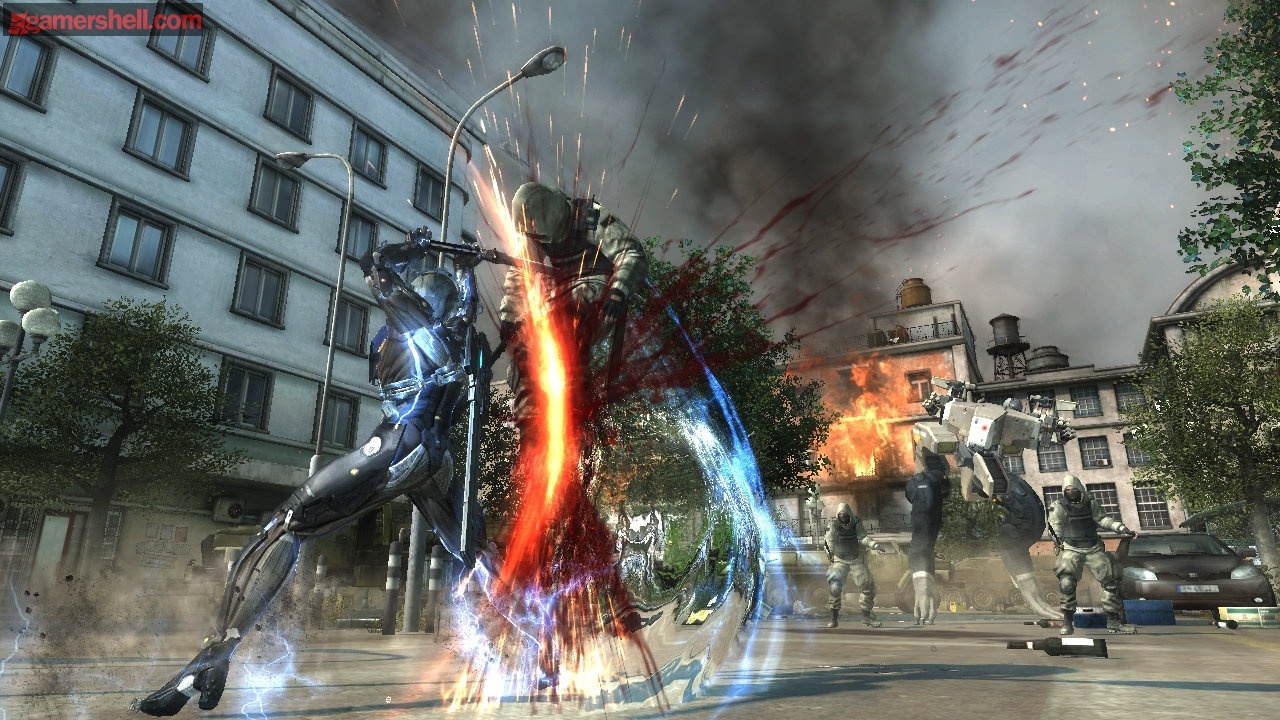
Players assume control of cyborg ninja Raiden, the katana-wielding ally of series mainstay Solid Snake. Unlike previous titles in the Metal Gear series, Rising is strictly an action game, focusing on swordfighting and a sophisticated cutting system. The game's cutting system allows players to engage in third person melee combat, as well as precisely slash enemies and objects "at will" along a geometrical plane using a "free slicing" mode. Virtually any object in the game can be cut, including vehicles and enemies, though elements of the environment were intentionally limited to structures such as pillars and walls to better facilitate gameplay. The free slicing mode is similar to other aiming modes in previous Metal Gear Solid titles, but produces a special targeting reticule in the form of a transparent blue plane which can be rotated and moved, tracing orange lines across the surfaces of objects to indicate exactly where they will be cut; it can also be used to enter a bullet time state, giving players the opportunity to precisely slash targets during moments of action, such as slicing through a falling target from multiple angles before it hits the ground. These features can be employed strategically, for example disabling opponents, finding weak points and gaps in armor, severing support columns to collapse ceilings or walls onto enemies, deflecting enemy fire, or cutting through objects to remove enemy cover.

Although Raiden's main weapon will be his high-frequency blade, he will also have "sub-weapons", Kimura revealed; gameplay footage has briefly shown Raiden wielding a dagger in his left hand. In the debut trailer for the rebooted titled, Raiden was also seen grappling and throwing large robotic enemies, and dramatically increasing his running speed for short bursts.

A key gameplay feature initially announced for game was titled zan-datsu (斬奪 lit. "cut and take"?), and would have involved "cutting" through enemies and "taking" parts, energy, ammunition, items, and information from the bodies of dismembered cyborgs and robots. For example, in the E3 2010 trailer, Raiden tears a battery — in the form of a glowing mechanical spine — from a dismembered cyborg enemy, which he then crushes after absorbing energy from it to heal himself. This gameplay element will not remain as the focus of the game, but will still be optional as of the move to Platinum Games, dialogue in the most recent trailer discusses such extracting of fluids from enemy cyborgs in order to obtain electrolytes.

The game's original director, Mineshi Kimura, stated that Rising would carry on the series tradition of encouraging players to progress through the game without killing, noting that there is a moral difference between attacking cyborgs or robots and attacking human beings, and that there's a "certain virtue to simply disabling your enemies instead of killing them." While it was considered important to give the players freedom to do what they want, the game's original producer Shigenobu Matsuyama, indicated that players would never be rewarded for killing human opponents, and that the game will be designed so that players are never forced to do so.

Despite having thought out stories and scenarios for the game, Kojima Productions were finding it difficult to design the game around the cutting concept. The project was quietly cancelled in late 2010, and whilst Kojima had considered moving the project to developers abroad, he felt that a Japanese developer would be more suited to produce a ninja action game. In early 2011, Kojima approached Tatsuya Minami, president & CEO of Platinum Games, about restarting the cancelled project with them. Platinum Games accepted the project and took over development with Atsushi Inaba as producer, reworking the game from scratch using their own engine, whilst Kojima Productions handling cutscenes and story elements, revising the story to now take place after Metal Gear Solid 4 to reflect the new development style. This new version, now titled Metal Gear Rising: Revengeance, was first revealed via a trailer shown at the Spike Video Game Awards on December 10, 2011.

The trailer also confirmed that Raiden will once again be voiced by Quinton Flynn, who had previously stated that Konami had not contacted him regarding the game. While Platinum Games is confirmed to be part of the project, Bayonetta director Hideki Kamiya, initially thought to be involved, has confirmed he isn’t part of the games development. The game's title was changed to Metal Gear Rising: Revengeance to reflect that it isn't part of the main Metal Gear Solid series, but is instead a spinoff that takes place after Metal Gear Solid 4: Guns of the Patriots. Kojima also confirmed Rising will run at 60 frames per second, a requirement he personally requested to Platinum Games. Inaba took to his Twitter feed to address fans' concerns over the project. He has acknowledged the mixed reaction to the unveiling of Rising, but hopes gamers will spot "a glimpse of the future" in the trailer. Inaba promises its "love and respect will shine through." The negative reactions came from fans noticing the genre switching to a "hack and slash" game.

BioShock: Infinite


BioShock Infinite is an upcoming first-person shooter video game, and the third game in the BioShock series. Previously known as "Project Icarus", it is being developed by Irrational Games for a 2012 release on the Microsoft Windows, PlayStation 3 and Xbox 360 platforms. BioShock Infinite is not a direct sequel or prequel to previous BioShock games, taking place in an earlier period and different setting, though it features similar gameplay concepts and themes. The player controls a former Pinkerton agent, Booker DeWitt, as he attempts to rescue a woman named Elizabeth trapped aboard the collapsing air-city Columbia in 1912.

BioShock Infinite is a first-person shooter with role-playing game elements similar to the previous two games. As DeWitt, the player moves about the various structures of Columbia using a grappling hook, a series of railways connecting the buildings called the Skyline, and other transport means to search for Elizabeth. The player will gain weapons which can be used in numerous ways within the environment, including on the Skyline, to defeat enemies. DeWitt gains powers and abilities by using vigors and nostrums that are found through Columbia, the equivalent of BioShock's plasmids and tonics. Vigors grant activated powers such as telekinesis, electricity manipulation, or animal control (as seen by the manipulation of a flock of crows within the gameplay demo), while nostrums are passive abilities that can improve the player's strength or damage resistance. Unlike BioShock in which the player was able to use special Gene Banks to alter the loadout of plasmids and tonics they had, the choice to imbibe a certain vigor or nostrum is permanent and cannot be changed later in the game, placing emphasis on the consequences of the player's choices throughout the game. Infinite does not use EVE, the equivalent of magic points, for powering abilities gained by vigors or nostrums. Each container of vigor has a limited number of charges in it, and while more can be found around the game's environment, the player can only carry a limited number of vigors into battle, with more powerful vigors containing fewer charges. Nostrums are permanent changes to the character and cannot be removed once used. These come in two types, stable and unstable varieties, the latter referred to as "potlucks". Stable nostrums are more expensive, but the player knows exactly what effect applying the nostrum will gain them. Unstable nostrums are cheaper or can be found lying around the environment, but upon use, require the player to select one of four random effects to alter their character, an idea inspired by Heroes of Might and Magic according to Levine.
Once reunited with Elizabeth, who also has a set of such powers, the player must work together with her to escape Columbia. For example, Elizabeth can create a localized rainstorm on foes, which the player, as DeWitt, can then fire upon with an electricity-based attack, electrocuting the foes. The player will not be directly in control of Elizabeth, but instead she will react to the player and the current situation in a manner similar to the AI Director in Left 4 Dead, according to Levine. However, using Elizabeth's powers also harms her, an action compared to the choice of killing or saving the Little Sisters from the previous games. Elizabeth also has the ability to interact with the tears in the fabric of space-time, pulling objects from the other side to use within Columbia, escaping from battle through these, or repairing them. The player will need to protect Elizabeth, but will not need "to babysit and hand-hold" her through the game. Levine has stated that working with Elizabeth in the game is "in no way, shape, or form is this an escort mission", identifying that players reacted negatively to a late-game stage in the original BioShock in which they were tasked to protect a Little Sister.

Several different forces are at work opposed to the player's progress within the city. Furthermore, the player and Elizabeth are chased by both Songbird (sometimes simply referred to as "Him"), who is attempting to snatch Elizabeth from the player, and the Handymen (originally named Alpha), robotic-like monsters housing a human heart and head and with the ability to heal weaker units.

The Skyline is a rail-based system (originally designed for moving cargo around Columbia but later used for personnel transport) similar to the concept found in the Ratchet & Clank games and described by Levine as "a roller coaster, over another roller coaster, over another roller coaster"; players activate a wrist-mounted tool that DeWitt and other enemies wear to jump and hang onto the self-powered tracks. Players can jump onto, off of, and between Skyline tracks at any time, and may face enemies that use the system to attack; the player can use weapons in DeWitt's free hand to defend the character. The freedom of movement along the Skyline allows for several varieties of combat, including flanking, cover, and area-of-effect attacks through creative uses of the system.

Irrational Games has stated that the game's set pieces are not heavily scripted; this statement was made in response to reaction to a gameplay preview video released during the week of September 21, 2010, which, within ten minutes, demonstrated numerous elements of the game. The development team called the game's pacing "likeBioShock 1", and that while there will be some scripted set pieces, the developers want the player to be able to explore Columbia at their own pace. Unlike Jack or Delta, the silent protagonists of BioShock and BioShock 2 respectively, and who are guided by radio commands from a third party, DeWitt will be a vocal character, with dialogue designed to aid the player in leading DeWitt to complete his mission.

At the present time, Irrational Games has not committed to including a multiplayer element within the game. While the team will experiment with concepts for a multiplayer component, Levine has stated that they would only proceed forward if it had elements not otherwise found in multiplayer games like Halo or Call of Duty.

During Sony's E3 press conference on June 6, 2011 creative director Ken Levine announced on-stage that BioShock Infinite will support the PlayStation Move. Though some reports believed that a new Move controller would be produced for the game based on information from Sony, 2K Games debunked these stories, stating that no new hardware is being developed for the game.
BioShock Infinite was on display for the general video game audience at the 2011 E3, and won the "Best of Show" award from the Game Critics Awards, as well as "Best Original Game", "Best Action/Adventure Game", and "Best PC Game".

Wednesday, December 14, 2011

Trine 2


Trine 2 is a side-scrolling action platform and puzzle video game developed by Frozenbyte. It is the sequel to Trine and was released on Windows, GNU/Linux, Mac OS X, PlayStation Network and Xbox Live Arcade on December 7, 2011. Trine 2 will allow three players to play the iconic roles of wizard, thief, and knight in a simultaneous cooperative mode.

The adventure begins with our three heroes, the thief, the knight and the wizard, rediscovering the Trine which then brings them back together. They then decide to travel on a journey to save the kingdom from evil goblins and other fiends.

Friday, December 9, 2011

Saints Row 3


Saints Row: The Third (also known as Saints Row 3) is an open world action-adventure video game developed by Volition, Inc. and published by THQ. It was released on November 15th, 2011 in Australia and North America, and was released on November 18th, 2011 in Europe for Microsoft Windows, PlayStation 3 and Xbox 360. It is the third title in the Saints Row series, after the release of Saints Row 2 in 2008. As in Saints Row 2, the player controls the leader of the Third Street Saints. The game world is the fictional city of Steelport, and the story focuses on the gang war between the Saints and The Syndicate, a rival criminal group.

The Third retains the blend of third-person action and driving sequences in open world, urban warfare format that is traditional in the Saints Row series. The player, as the leader of the Third Street Saints, can explore the city of Steelport, performing main missions that progress the game's story, and side missions. These side missions include Activities, mini- initiated at various points in the game world, Strongholds, rival gang bases that can be taken over to control a section of Steelport and; Flashpoints, on-the-spot gang warfare. Successful completion of missions can earn the player in-game money, weapons, cars, and gang respect. Previous Saints Row games used respect as a way to unlock story missions; The Third uses respect as experience points which the player can then spend to improve specific attributes of their character, such as melee combat or firearms skills. A leveling system is introduced, and the player selects these attributes, or 'perks', each time the player character is leveled-up. Money can be used to purchase clothing items, weapons and cars, or may be used to upgrade weapons and cars with unique features, such as adding scopes or extra barrels to a weapon, which are then stored in the player's arsenal. Money can also be used to upgrade the Saints gang, customizing their appearance, outfits, and headquarters. The "Initiation Station" system allows players to upload their character creations to The Third's online community, and download other players' creations to use with their save-game. Within The Third, the player can set up to four different appearance styles for their gang. Finally, money is also used to purchase shops and other properties within Steelport, which in turn will become a steady stream of income for the gang over time.

While completing some missions, the player may be given a choice of options to finalize the mission. For example, the player has the option of using a gigantic bomb to demolish one of the skyscrapers in the city; though they will gain a great deal of respect for the action, it will alter the city's skyline for the rest of the game and cause non-player characters to react differently to the player, while leaving the building standing allows it to be used as a headquarters for the Saints. New Activities have been introduced alongside many from previous Saints Row games.

The player's arsenal is presented as a pop-up compass through which weapons are equipped with the analog stick. Novelty weapons are introduced alongside the traditional arsenal of handguns and automatic weapons. Players will gain the ability to call down airstrikes on encamped enemies, or to use a remote control electric bug to control vehicles remotely. Unlike the first two games, there are no health recovery items in favor of improving the grenade throwing system; in exchange, the player's health will regenerate at a faster rate as long as they stay out of the line of fire. Nearly all actions in the game can be sped up by holding down a second controller button, dubbed by Volition as the "awesome button"; for example, when carjacking, holding down this button will cause the player character to missile-kick the driver out of the seat in short order.

In addition to the single-player mode, the game can be played co-operatively with one other player. As in Saints Row 2, the second player can participate in all missions and activities, earning credit for their completion. Certain activities provide different rules when a second player is present; for example, in the Tiger Escort activity, the second player will have to control the tiger in the backseat while the first player drives. Because of their focus on the single player and co-operative experience, Volition has removed competitive multiplayer from the title. Co-op features will, however, require an online pass.

On November 2, 2011, THQ CEO Brian Farrell announced that Saints Row: The Third is already the most pre-ordered title in series history. In fact, the game has four times the number of pre-orders Saints Row 2 had two weeks before its launch. THQ estimates the game will ship over 3 million units before the publisher's fiscal year ends in March 2012. By comparison, Saints Row 2 launched in October 2008 and sold 2.6 million by the end of the fiscal year. Saints Row: The Third debuted at fourth place at the UK video game sales chart in its first week, beating the week one sales of Saints Row 2 by 93 percent.

During an interview with X-Play, THQ executive VP Danny Bilson revealed that Volition is already working on Saints Row 4. "Like any game, if you have a great creative core to it you just keep exploiting that core," he told G4. "For instance," he continued, "I know what Saints Row 4 is about and it is wilder than this one. It's a good example of how you take what you have and you ask, 'what could happen in the next?" added Bilson, without giving up any actual details.

Thursday, December 8, 2011

Uncharted 3: Drake's Deception


Uncharted 3: Drake's Deception is the third game in the Uncharted series, created by Naughty Dog for the PlayStation 3, and was released in North America on November 1, 2011, Europe on November 2, 2011 and Australia on November 3, 2011. It is the sequel to 2009's Uncharted 2: Among Thieves. It was first revealed on December 9, 2010. Officially it was announced at the 2010 Spike Video Game Awards on December 11, 2010.

Uncharted 3 sees protagonist Nathan Drake and mentor Victor Sullivan traveling around the world to such places as the Rub' al Khali desert, in search of the legendary lost city, the Iram of the Pillars. Chloe Frazer and Elena Fisher also return in Uncharted 3. The plot draws from the archaeology days of T. E. Lawrence. Arne Meyer, Naughty Dog's community strategist stated that the "main theme of Uncharted 3 is 'finding the way'". Upon its release, Uncharted 3 was met with high critical acclaim, averaging 92% on both review aggregate websites Metacritic and GameRankings, making it one of the most critically acclaimed video games of 2011 for the PlayStation 3 on both websites.

Uncharted 3: Drake's Deception is an action-adventure game played from a third-person perspective, with the player in control of Nathan Drake. Drake will have a large number of different animation sets, enabling him to react according to his surroundings. Drake is physically adept and is able to jump, sprint, climb, swim, scale narrow ledges, wall-faces to get between points, and perform other acrobatic actions. Drake can now take on opponents in more ways than before: hand-to-hand combat with multiple opponents, contextual melee attacks, and new stealth options. Uncharted 3 also features expanded and diverse traversal moves with deep gunplay. Drake can be equipped with up to two firearms – one single-handed and one two-handed – and four grenades. Drake can pick up weapons, automatically replacing the existing weapon he was using, and additional ammunition from downed enemies.

The player can direct Drake to take cover behind corners or low walls using either aimed or blind-fire to kill his enemies. The player can also have Drake fire while moving. If Drake is undetected by his enemies, the player can attempt to use stealth to take them out, such as by sneaking up behind them and killing them with one hit, or by pulling an unsuspecting foe over a ledge from which Drake is hanging. The stealth mechanic has been simplified and improved. Some areas of the game will require the player to solve puzzles with the use of Drake's journal, which provides clues towards the puzzles' solutions. When enabled, a hint system provides gameplay clues, such as the direction of the next objective.

During the first week of sales in the United Kingdom, Uncharted 3: Drake's Deception became the second best selling game on the all-format chart, beaten only by EA's Battlefield 3. It became the 11th best ever PS3 launch in the UK, and outperformed its predecessor's launch week sales by 37 percent. Uncharted 3 fortunately topped the PS3 and Individual Platforms charts, replacing Battlefield 3. During the first week of sales in Japan, Uncharted 3 became the second best selling game on the chart and sold 124,989 copies, beaten only by Nintendo's Super Mario 3D Land.
Worldwide, the game broke all records for the Uncharted franchise, in the sales department, firmly ahead of the last game in the franchise. It shipped 3.8 million copies globally on launch day, making it "one of the best-selling titles of 2011, putting the third installment on a clear course to be the biggest selling game in the trilogy", Sony said in a statement.

Serious Sam 3: BFE


Serious Sam 3: BFE is a first-person shooter video game developed by Croteam and published by Devolver Digital. It is the latest game in the Serious Sam series and a prequel to Serious Sam: The First Encounter. The game's story takes place in the 22nd century, during Mental's invasion of Earth, as implied in The First Encounter. The game is set in Egypt and features a 16-player co-operative campaign mode, as well as 4-player splitscreen. The game was released on November 22, 2011 on Steam. Console release dates have not been revealed.

BFE has garnered fairly positive reviews. Eurogamer gave the review a 7 on 10, praising the game for what Duke Nukem Forever failed to deliver, however criticizing the redundancy of the title's gameplay compared to its previous iterations in the series. Game Informer rewarded the game a score of 7.75 and praised the game for its graphics and the heavy metal score while being true to its original concept. Destructoid gave it an 8.5, saying "It's a lot of fun indeed. A lot of backbreaking, grueling, soul-destroying fun." It received mixed reviews by Metacritic with a score of 70 out of 100 based on 6 reviews. GameRankings rated the game with a score of 77.55% based on 10 reviews.